
Five Tokens Are Defying the Cryptocurrency Market Downturn
Crypto had a rough week: Bitcoin fell more than 15%, while Ethereum, XRP, and Solana dropped over 21%. Against that selloff, $1WIN, NIGHT, PIEVERSE, Jupiter, and WLFI showed relative strength. $1WIN stayed above its $0.03 public-sale price, NIGHT rose more than 16%, and PIEVERSE gained around 24%. The article explains that relative strength does not mean immunity, but resilience when most assets decline. It links some gains to existing platforms, privacy infrastructure, or payment-focused projects, while cautioning that buybacks, burns, and token launches do not guarantee price performance.
Club desk Updated 2026-11-21 0 replies
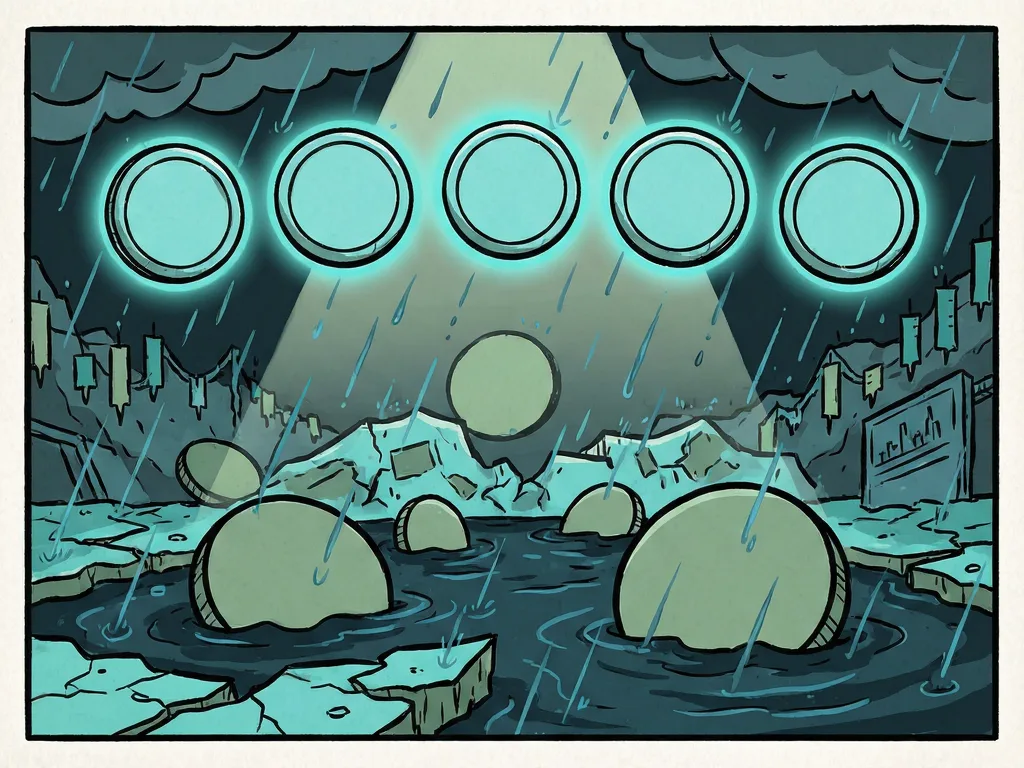
Crypto has had a rough stretch, and the scale of the decline has made small gains stand out. Bitcoin has been heading through its longest losing streak of the year, with BTC falling more than 15% in a week. In the same period, Ethereum was down 21%, while XRP and Solana were listed as down 22%. Against that backdrop, five tokens showed relative strength: $1WIN, NIGHT, PIEVERSE, Jupiter, and World Liberty Financial’s WLFI.
What happened to Bitcoin and the largest altcoins?
The market summary describes a broad selloff across major crypto assets. Bitcoin’s weekly decline of more than 15% sets the tone for the rest of the market, while Ethereum’s 21% drop shows that large alternative cryptocurrencies were also under pressure. XRP and Solana were reported down 22% in the same general market overview.
That context matters because relative strength is easiest to notice when most assets are falling. In a week where double-digit declines became normal, even modest positive returns can look unusual.
What does relative strength mean during a selloff?
Relative strength means an asset is not necessarily rising because it is immune to market pressure. It means the asset held up better than the broader market, or gained while nearby assets lost value.
In this case, the report highlights where buyers still appeared while much of crypto was being sold. The five tokens are not presented as guaranteed winners. They are presented as examples of assets that stayed green, or at least showed resilience, during a difficult week.
$1WIN stayed above its $0.03 public-sale price after a November launch
The first token mentioned is 1win Token, or $1WIN. Its launch was awkwardly timed: its November token generation event arrived just as crypto’s latest downturn accelerated. Despite that, the report says $1WIN was trading around $0.045 this week, roughly 48% above its $0.03 public-sale price. It also gained around 8% over the last day.
The key point is not only the price, but the position above the public-sale price. When major assets were suffering double-digit weekly declines, staying above the sale price stood out.
The report links $1WIN’s performance likely to the platform’s existing business. 1win has operated since 2016 and has over 10 million users, and its gaming business is described as profitable independently of the token. The platform also plans regular buybacks funded by gaming revenue, while 10% of $1WIN spent through supported platform products will be burned.
For newcomers, “burned” means tokens are removed from circulation. Buybacks and burns can affect supply, but the source does not claim they ensure price strength. The source simply connects the token’s relative performance to the platform’s established user base and profitable gaming activity.
NIGHT gained more than 16% as privacy infrastructure stayed in focus
Midnight’s NIGHT is another exception to the downturn. CoinMarketCap data showed NIGHT up more than 16% over seven days, even as Bitcoin and most large-cap altcoins moved sharply lower.
NIGHT is associated with a privacy-focused network. The project is developing zero-knowledge infrastructure designed to allow applications to handle sensitive data without placing everything publicly on-chain.
Zero-knowledge systems are a category of cryptographic tools that can let one party prove something is true without revealing all the underlying data. In blockchain contexts, that can matter when applications need privacy, verification, or selective disclosure. The source does not expand beyond this basic description, and the value here is that NIGHT showed strength while the broader market fell.
PIEVERSE rose around 24% even after pulling back from recent highs
PIEVERSE moved more aggressively against the market than some of the other names in the list. The token remained around 24% higher over seven days, despite pulling back from recent highs.
The project is building payment infrastructure designed around verifiable on-chain invoices and receipts. It also includes payments initiated by AI agents.
This makes PIEVERSE different from the privacy-focused description of NIGHT. PIEVERSE is framed around payments and receipts, while NIGHT is framed around privacy and zero-knowledge infrastructure. Both projects are described as having technical products, but the source does not claim those products alone caused the price moves. The factual point is the seven-day gain of around 24% and the pullback from recent highs.
Jupiter gained around 10% through November 15 while Solana fell
Jupiter, represented by the token JUP, is another example of resistance within a weak market. Jupiter has expanded beyond its original role as a swap aggregator. A swap aggregator is a tool that searches available liquidity or trade routes to help users execute token swaps. Jupiter is now described as extending into perpetuals, lending, prediction markets, and other on-chain financial products.
The report says SOL fell roughly 20% over the week, while JUP recorded a weekly gain of around 10% through November 15. JUP was then up another 6% in the latest 24-hour session.
There is a small timing difference in the source: Solana was earlier listed among assets down 22%, while the Jupiter section says SOL fell roughly 20% over the week. The important comparison is that JUP rose while SOL declined, and the Jupiter section specifically ties the weekly gain to November 15.
For readers, the point is that Jupiter was part of Solana DeFi activity, but its token price did not simply follow the broader decline of Solana. The source frames this as resistance rather than proof of long-term strength.
WLFI gained roughly 2% while Bitcoin lost around 14%
World Liberty Financial’s WLFI is less dramatic than the other names, but resilience counts when almost everything else is falling. WLFI gained roughly 2% over the week, while Bitcoin lost around 14% in that section’s comparison.
The WLFI section uses a Bitcoin figure of around 14%, while the opening market summary says BTC fell more than 15% in a week. Again, the source presents different numbers in different parts of the report. The consistent idea is that Bitcoin declined, and WLFI held up better than the broader market.
CoinMarketCap data also noted that WLFI declined less than the overall market during several recent risk-off sessions. “Risk-off” describes periods when traders reduce exposure to volatile assets and move toward lower-risk positions or cash. In that environment, a token losing less than the market can be considered relatively resilient.
Why relative strength matters in a selloff
The five tokens show where buyers are still appearing while much of crypto is being sold. In a market where double-digit weekly losses have become normal, staying green is enough to stand out.
That is the central lesson of the report. Bitcoin’s decline, Ethereum’s drop, and the weakness in XRP and Solana create the baseline. Within that baseline, $1WIN stayed above its public-sale price, NIGHT gained more than 16%, PIEVERSE remained around 24% higher, Jupiter gained around 10% through November 15, and WLFI gained roughly 2% while Bitcoin lost around 14%.
What readers should take from the numbers
For newcomers, the useful takeaway is not that these five tokens are automatically better than Bitcoin, Ethereum, XRP, Solana, or other assets. The useful takeaway is that relative strength can reveal pockets of demand during a broad decline.
The source does not provide price predictions, targets, or claims about future returns. It provides a snapshot of a difficult week and highlights five tokens whose price behavior differed from the market majority. Some of the projects are tied to existing platforms, privacy technology, payment infrastructure, Solana DeFi products, or World Liberty Financial, but the report’s main factual point remains simple: when most assets were falling, these five showed relative resilience or gains.