
This Is How the Society for Worldwide Interbank Financial Telecommunication Will Adopt Ripple's Native Cryptocurrency in Its Back-End Systems
SWIFT adoption of XRP is only an opinion; the pilot uses tokenized deposits, while ODL, bank ties, and XRP price weakness are key.
Club desk Updated 2026-11-26 0 replies
What is the claim about XRP Ledger and SWIFT?
A popular software engineer, Vincent Van Code, shared an opinion on November 18, 2026 about Ripple’s XRP Ledger and its possible ties to SWIFT for cross-border remittances. His view was that XRP’s chain is mainly built to handle cross-currency conversion and liquidity problems by using XRP as a bridge asset, not simply to send basic payments. In that framing, the ledger solves currency-conversion problems, not payment problems alone.
Why would SWIFT care about XRP Ledger?
Traditional financial messaging systems can take several business days to settle transactions. The source says SWIFT is looking for a way to process transactions in seconds instead. XRP Ledger’s built-in DEX and AMM can convert currencies on-ledger in 3-5 seconds, according to the claim. That speed is the main advantage described.
A DEX is a decentralized exchange, and an AMM is an automated market maker. For a newcomer, the key point is that the technology can swap one currency into another without relying on a slow, manual bridge between banks.
How would XRP work as a bridge asset?
In cross-border transfers, two currencies may not have a direct market. A bridge asset can help one currency convert into XRP, then into another currency. The source describes this as XRP being used for cross-currency conversion and liquidity, not just as a payment method.
Vincent Van Code’s post said SWIFT would eventually adopt XRP currency settlement in its backend, using XRP as a settlement intermediary. The text presents this as his opinion about a future integration, not a confirmed plan.
What role does On-Demand Liquidity play?
Another important point is Ripple’s On-Demand Liquidity. The source says it provides liquidity on demand without pre-funded nostro accounts. In simple terms, nostro accounts are funds a bank keeps with another bank in advance. If liquidity can be accessed when needed, the article says XRP could work both as a bridge cryptocurrency and as part of the infrastructure layer for immediate payment settlements.
Which banks are linked to Ripple’s technology?
The article says HSBC, Standard Chartered, BNP Paribas and DBS Bank have all participated in on-chain transactions through Ripple’s technology stack one way or the other. It also says those Ripple connections relate to custody infrastructure and tokenized assets.
The source says SWIFT started its own 24/7 ledger in November and tested it on multiple Ripple-affiliated banks.
Is the SWIFT pilot an XRP integration?
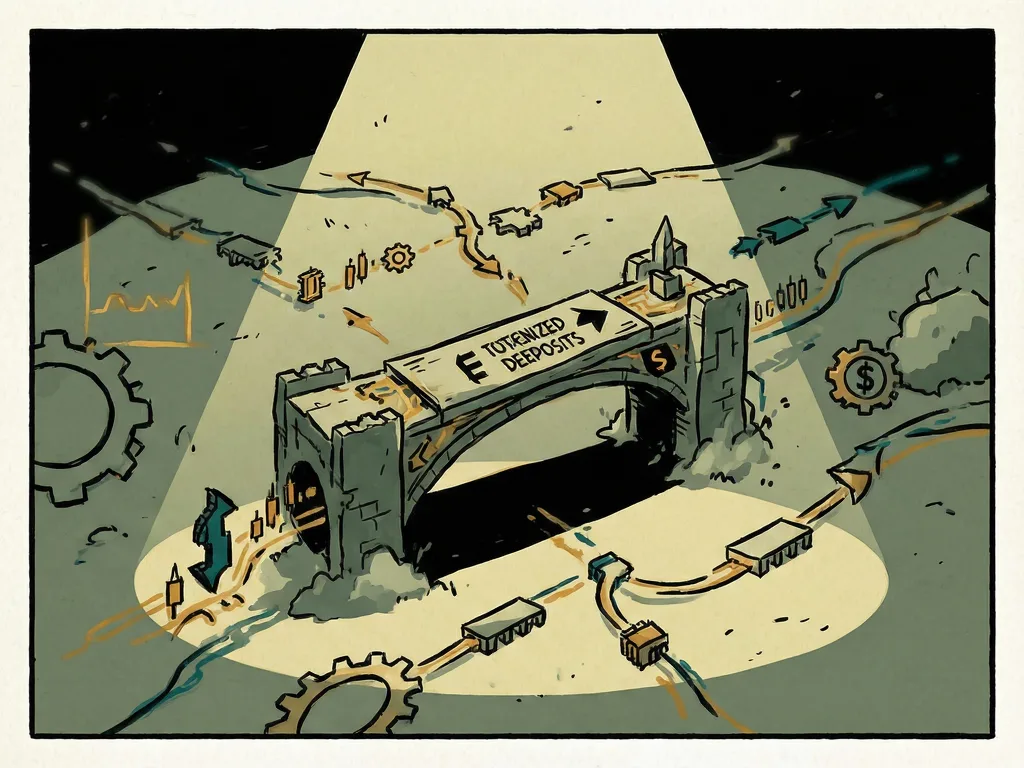
The text says no. The SWIFT pilot uses bank-issued tokenized deposits orchestrated on SWIFT’s permissioned ledger, not via XRP. A permissioned ledger is a network where access and participation are controlled by known parties. Tokenized deposits are digital forms of bank deposits.
So, even if Ripple and SWIFT both appear in the discussion, the pilot described is not an XRP integration. The “On The Flipside” summary repeats this: several major banks in the SWIFT group have independent Ripple technology relationships, but the on-chain pilot itself is not an XRP integration.
What happened to XRP’s price and market data?
The source says XRP’s native coin has been weak. It describes XRP as the OG altcoin and says it broke below the $0.99 lower price boundary of a channel. The article says that suggested a deeper correction may be underway.
Analyst Ali Martinez is cited in the source with a technical view pointing to a support bubble between $0.64 and $0.80. Ali Charts posted on November 20, 2026 that XRP had broken below the $0.99 lower boundary and that the next major support levels being watched were $0.80 and $0.64. The post also said that for the bearish outlook to weaken, XRP would need to reclaim a higher level, without giving the full sentence.
What did the futures market show?
Friday’s crypto market dip removed multiple millions of dollars in Futures volume. The source says XRP bulls were liquidated unevenly against short-sellers. Using a real-time long versus short liquidation map, CoinGlass data accounted for $14.11 million out of $14.71 million in liquidations.
Traders were caught off guard by XRP’s dip below $0.94. The text says leveraged markets showed lopsided price movements and that bulls would need to defend a multi-year major demand territory. Because XRP has high price correlation with Bitcoin (BTC) and ETH, the source says the chance of restoring the $1 psychological level this week was described as slim. XRP Futures volume rose 20.82% from yesterday, and the article says bulls do not seem to give up.
Why does this matter for new readers?
The source’s “Why This Matters” section says blockchain integration with traditional financial systems becomes inevitable when major financial groups such as SWIFT seek instantaneous settlement solutions.
For a newcomer, the key takeaway is that the market is watching two different things: technical settlement links and price activity. The XRP Ledger discussion centers on speed, currency conversion and liquidity. The SWIFT pilot described centers on tokenized deposits on a permissioned ledger. XRP’s price story is separate, but both can affect how users and institutions view the asset.
What other related headlines were mentioned?
The article ended with a link to DailyCoin’s other trending crypto stories, including a headline about XRP recovering $1 and another about MEXC pulling the plug on a VISA card months after launch.