
Anthropic's IPO was amazing with an $83 billion valuation, an $81.3 billion raise, and a $1.5 trillion record.
Anthropic's IPO raised $81.3 billion at a $1.5 trillion valuation, the largest US IPO ever. Trading was expected to begin on Nasdaq under ANT.
Club desk Updated 2026-11-22 0 replies
What is the Anthropic IPO?
Anthropic, the maker of Claude, said on November 18, 2026 that it had priced its initial public offering at $83 a share and raised $81.3 billion at a $1.5 trillion valuation, described as the largest U.S. IPO ever. The round was led by Google and Spark Capital. Anthropic said a registration statement relating to its Class A common stock was declared effective by the U.S. Securities and Exchange Commission on November 18, 2026, and trading was expected to begin on Nasdaq on Nov. 19 under the ANT symbol, beating the previous record set by SpaceX. The final price was above the marketed range of $70 to $78.
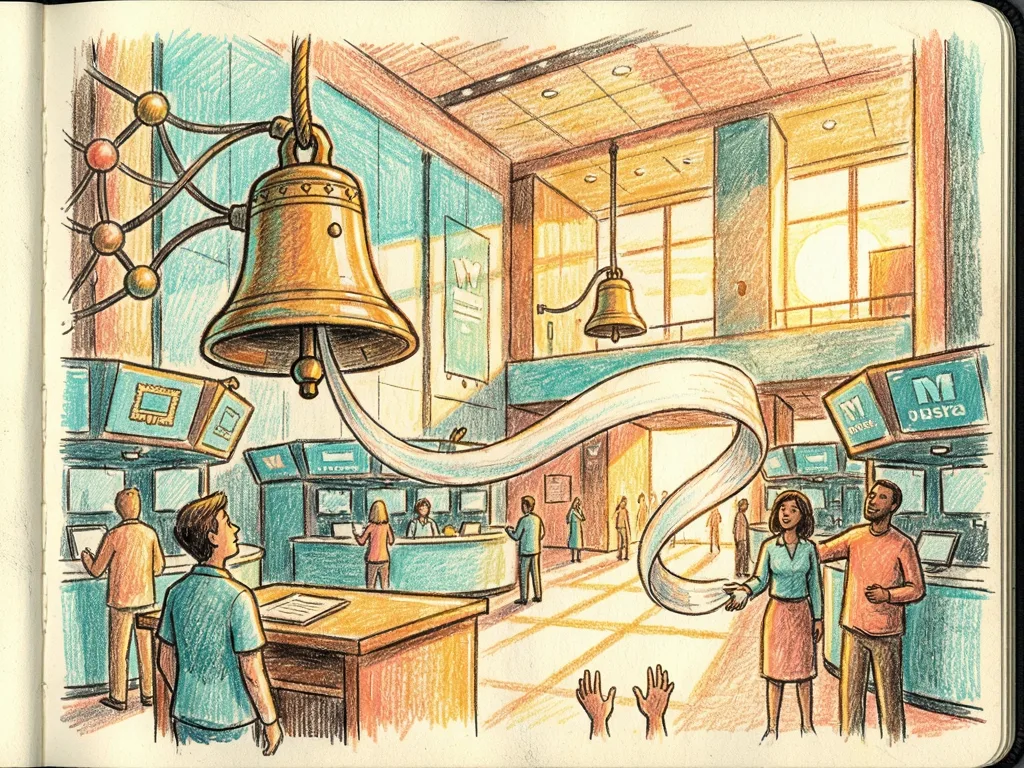
An IPO is when a private company sells shares to public investors for the first time. In this case, Anthropic sold shares to raise money from public markets and also arranged a separate $26 billion private placement with Google and NVIDIA. A private placement is a sale of shares to selected large investors rather than to the general public.
Why did the offering become so large?
The size of the deal came from both demand and supply. Interest reached nearly seven times the number of shares on offer, prompting Anthropic to increase the offering from 825 million shares to 980 million shares. When large investors order more shares than are available, a company may expand the sale to meet that demand.
The buyers included companies that are not just financial investors. Google is a cloud partner and investor, while NVIDIA supplies accelerated computing used to train large AI models. That places the listing at the center of three layers of the AI industry: compute, cloud, and model platforms.
The offering also reflected how much large institutions are willing to pay for access to leading AI systems even when public markets have shown concerns about AI valuations and weaker technology stocks.
What does a $1.5 trillion valuation change?
A valuation anchor is a reference point for what investors are willing to pay for companies in a given sector. At $1.5 trillion, Anthropic could become one of the largest listed technology names. That matters because index funds, passive investment flows, and private-market valuations often use public-listed companies as comparison points.
For private AI startups and crypto-focused AI teams, the number may influence how investors think about their own value. For venture funds and technology investors, it may influence how they divide money among AI equities, AI-linked tokens, blockchain infrastructure, and private-market venture capital exposure.
Before the final price, the deal had been discussed alongside a $90 billion offering that was nearing, valuation talks that dropped toward $1.2 trillion after a selloff, and a filing that revealed nearly $900 billion in future AI commitments. Some reporting also framed the near $90 billion offering as a possible pressure point for Bitcoin liquidity. Those details show that the final $83 price, $81.3 billion primary raise, and $1.5 trillion valuation were the result of a longer negotiation process.
Why are crypto investors watching an AI company with no token?
Anthropic has no blockchain and no token, so this is not a token launch. It is a capital-markets event. The connection to crypto is indirect, but it can affect how investors think about liquidity and risk.
First, large public offerings can pull money away from other assets. The $81.3 billion primary raise, plus the $26 billion private placement, means capital is being allocated to Anthropic shares rather than to venture funds, liquid token funds, or public-market crypto companies such as Coinbase or Circle. Crypto investors often watch these flows because the same pools of capital can move between technology stocks, digital assets, and private markets.
Second, the valuation can raise expectations for open AI projects. In the past two years, crypto and AI have overlapped through ideas such as distributed compute networks, AI agents, and tokenized GPU marketplaces. If public investors pay a premium for proprietary models, projects competing on openness, censorship resistance, or cost may be judged against a higher bar. Teams deploying to Bittensor, Solana, Near, and Ethereum may need to show differentiation beyond simply making models accessible.
Third, the same institutional investors evaluating ANT may also be looking at regulated crypto products, including spot Bitcoin and Ether ETFs. An AI listing does not change crypto rules, but it shows how institutional capital is choosing between AI equities and digital-asset exposure.
What does this mean for users?
For most readers, the direct effect is not a new product or a new token. The effect is about where money goes and what becomes considered expensive or important in technology. If a leading AI company can list at a $1.5 trillion valuation, it may reinforce the idea that AI infrastructure is a major asset class for large investors. That can influence which startups get funded, which tools become enterprise products, and which crypto-AI projects feel pressure to prove they are different from centralized AI providers.
For crypto users, the story is mainly about capital flows and valuation comparisons. A large IPO can reduce available liquidity for riskier assets in the short term, but it can also validate AI-related narratives that crypto projects have been trying to build around decentralized compute, agent payments, and open model access.
What comes next for investors and builders?
The immediate milestone is the Nasdaq debut under ANT. Price discovery begins when trading starts, and the market will show whether the $83 price reflected sustained demand or impatient speculation. Further indicators will include lock-up releases, quarterly results, and disclosures about revenues, margins, and enterprise adoption of Claude. A lock-up is a period after an IPO when early investors and insiders may be restricted from selling shares, so its release can change supply.
For regulators, the listing may draw attention to AI concentration, meaning the possibility that a small number of companies control major parts of the AI stack. That can lead to more data disclosure requirements, including filings with the SEC. For crypto developers, the choice may be between partnering with large AI providers or building independent infrastructure. Areas such as verifiable inference, on-chain model origin, and agent payments in stablecoins could allow crypto projects to serve as complementary infrastructure rather than direct rivals.
Stablecoins are digital assets designed to keep a stable value relative to a reference asset, and they are increasingly discussed as a settlement layer for machine-to-machine payments as AI agents become more common. The Anthropic IPO does not settle the debate about whether AI is in a bubble. It does show that institutional demand for leading AI systems was strong enough to support the largest-ever U.S. listing.